Iran's Massive Loss
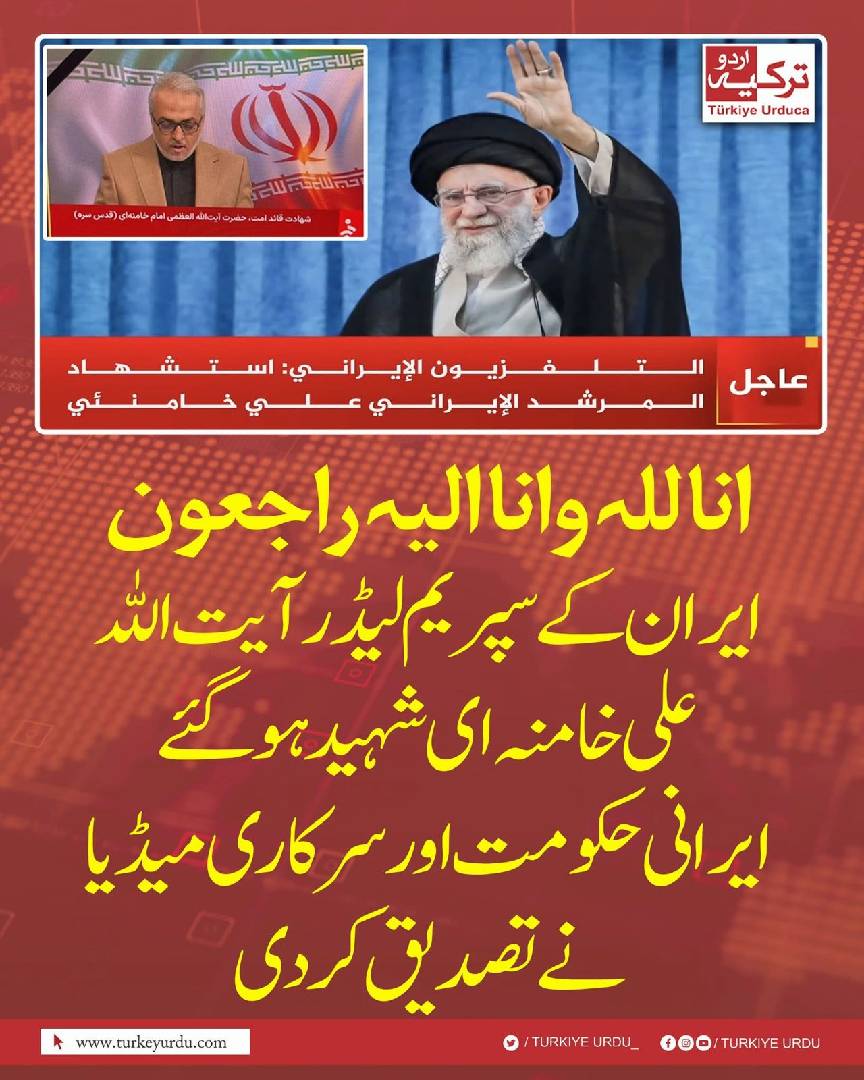
Iranian official media confirmed this morning that Supreme Leader Ayatollah Ali Khamenei was martyred in the Antichrist (Dajjali) airstrikes on Saturday. A few hours before this announcement, US President Donald Trump had also given this news. However, it was initially denied by Tehran, but later it was officially confirmed at the state level, and a 40-day mourning period along with a 7-day official holiday was announced in the country.
In its statement, Iran's Supreme National Security Council declared Khamenei's martyrdom as the starting point of a new struggle against global despotic (Taghooti) forces. The Revolutionary Guards also announced plans to take revenge. According to the Iranian news agency Fars, the attack took place while the Supreme Leader was performing official duties in his office. According to unconfirmed reports, some of his close family members were also targeted in these attacks.
On the other hand, President Trump described the operation as justice for both the Iranian people and Americans. According to him, the Iranian leadership could not escape modern intelligence and surveillance systems. In interviews given to American broadcasters NBC News, CBS News, and ABC News, Trump claimed that a large part of the central decision-making leadership in Iran has been eliminated, and a change in leadership is now inevitable. He also stated that the bombing would continue for at least a few days and could be extended if necessary.
In an interview with the American website Axios, Trump indicated that he has alternative paths available besides military action, but he claimed that Iran had attempted to restore its nuclear infrastructure in recent months, which made this attack inevitable. Independent observers have pointed out construction activities, but evidence of a full restoration of the nuclear program has not emerged.
According to Al Jazeera, this attack by the Antichrist forces is not merely a military operation but could prove to be an earthquake for the Iranian state structure as well as the entire region. Khamenei held the most powerful position in Iran for more than three decades and determined the direction of state, military, and religious institutions. The vacuum created by his departure has raised important questions regarding the continuity of leadership.
In recent days, reports were circulating in some global media outlets that 67-year-old Ali Larijani could be brought forward as a deputy or potential successor. Larijani has been associated with the Revolutionary Guards in the past, has served as the Speaker of Parliament, and currently holds influence in key state institutions. However, no definitive official announcement regarding the appointment of a new Supreme Leader or acting leader has emerged. Iran's constitutional procedure requires the election of a new leader through the Assembly of Experts (Majlis-e-Khubregan-e-Rahbari), so the next few days will be decisive.
Against the backdrop of the success of this attack, questions of internal security are also being raised. A perception exists in Iranian circles that access to such a high level was not possible solely through foreign technology, but internal weakness or leakage of information must have played a role. Iran has conducted operations against internal networks in recent years, but this incident has highlighted the vulnerabilities of the security apparatus.
Militarily, the real battle in the current phase is over missile and air defense systems. Iran's retaliatory capability depends on its ballistic and cruise missile programs. Until the US and Israel completely neutralize Iran's missile installations and launching sites, the possibility of retaliation will remain. However, a ground attack or direct occupation of Iran seems far-fetched at present, because Iran's geography, population, and military structure would demand a long and expensive campaign for any foreign power.
Politically, this crisis can go down two possible paths: either the hardline factions will become stronger and expand their resistance strategy, or a new balance will emerge after a leadership change that opens the way for limited compromise or renegotiation. The Trump administration's simultaneous mention of military pressure and diplomatic possibility reflects this two-pronged strategy. Trump states that the path to a political settlement is much easier today than it was yesterday.
Currently, Iran stands at a critical juncture. The leadership vacuum, internal security concerns, reliance on missile power, and global pressure—all these factors are combining to make the coming days extraordinarily important. If the state structure manages the succession phase in an organized manner, the system can maintain its survival; but if internal strife increases, this event could also prove to be the beginning of a new era in Middle Eastern politics.