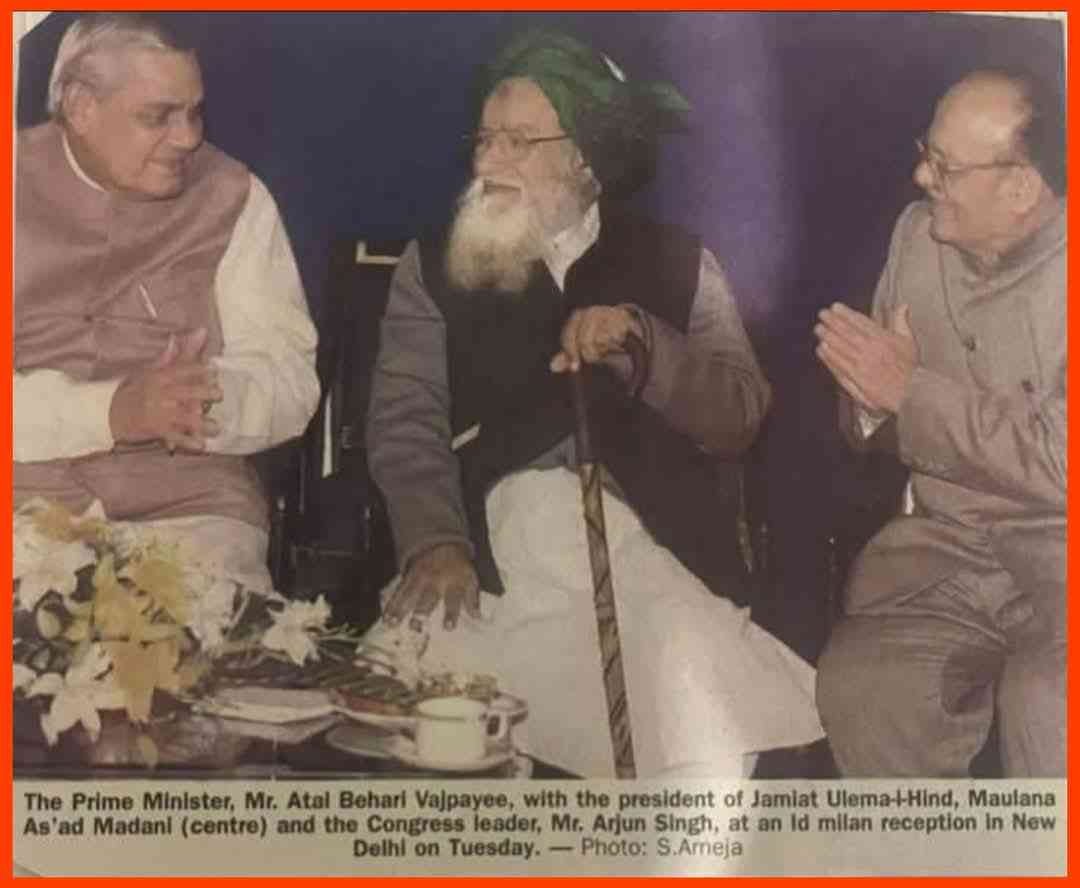
"Man kana lillahi kanallahu lahu" (Whoever belongs to Allah, Allah belongs to him) & "Wa tu'izzu man tasha'u wa tudhillu man tasha'u" (And You honor whom You will and You humiliate whom You will) 💚

On the right side of Fidai-e-Millat Hazrat Maulana Sayyid Asad Madani (Noorallahu Marqadahu), the Prime Minister, and on his left side, a minister can be seen with folded hands.

This was the power of the Ulama of Deoband that great powers used to bow down and salute them with utmost respect and honor.

At that time, governments used to respect the Ulama of Deoband; now, governments are showing disrespect to the stature of the Ulama.

May Allah Almighty shower crores (millions) of mercies upon the grave of Fidai-e-Millat Hazrat Aqdas Hazrat Maulana Sayyid Asad Madani (Noorallahu Marqadahu) 🤲🤲

ارے بھائی!

اگر آپ ہزاروں کتابیں، نعتیں، تصاویر، ویڈیوز، اخبار، مضامین، قبلہ نما، اوقات نماز، اسلامک گھڑی اور بہت کچھ آسانی کے ساتھ حاصل کرنا چاہتے ہیں تو بس ہمارے Islamic Tube ایپ کو پلے سٹور سے انسٹال کرو، اور بالکل مفت اور آسانی کے ساتھ اسلامک مواد حاصل کرو

ڈاؤن لوڈ کریں
Image 1

The cultural invasion of Christianity!!

The cultural invasion of Christianity!!

As long as the Christian religion was not aligned with politics, every nation in the world had its own distinct attire. Even now, wherever Christianity has not influenced a nation's politics, that nation still retains its own specific national dress. In the countries where Christianity arrived in alignment with politics, the national attire of those places has been hidden away in an old trunk, much like the "garb of slavery" of Mahmud Ghaznavi's favorite slave, Ayaz, which is only occasionally brought out on festivals like Eid merely to refresh old memories. Consequently, the Christian attire—coat, trousers, and necktie—has now become an international dress, which is worn not only by Christians but by the inhabitants of every religion, country, and nation. As far as the coat and trousers attire is concerned, it is difficult to judge a person's nationality just by looking at it. Yes, however, one can determine from the complexion of the face or the spoken language whether a certain person is an American or a Pakistani. (Excerpt from the book "Ooper Sherwani Andar Pareshani" by the renowned writer and journalist Ibrahim Jalees)