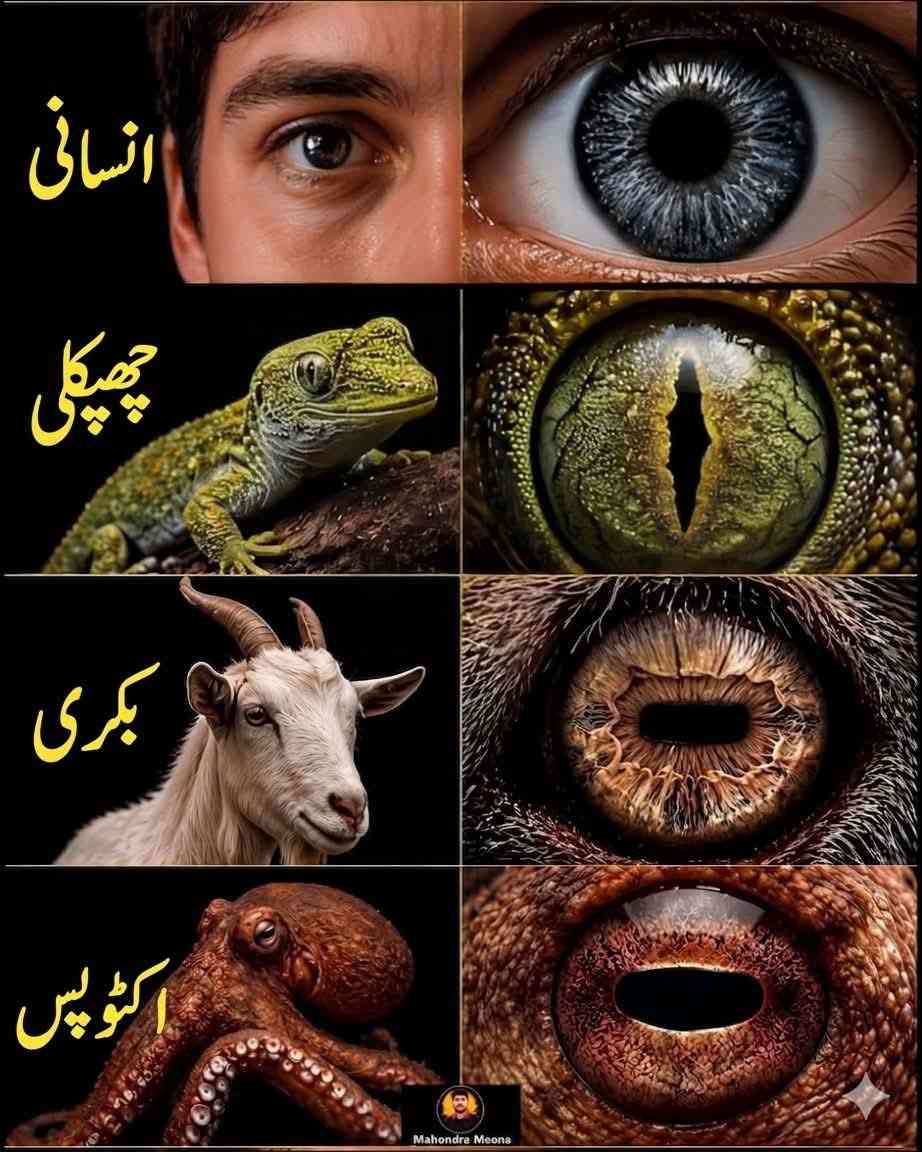
No eye is perfect! 👁️

Have you ever thought that the ability to see better also comes at a cost?

Nature has designed every eye not for perfection, but for survival. Let's see how:

👁️ Human

The human eye is sharp, focused, and excellent at recognizing colors.

But: It has a 'blind spot' and its side vision (peripheral view) is limited compared to many animals.

🦎 Lizard / Gecko

It can see even in extremely dim light and can recognize colors almost in the dark.

But: In bright light, its vision gets dazzled very quickly.

🐐 Goat

A goat's rectangular pupils show it a wide view (Panoramic view) of up to 320 degrees so that it can see the enemy from afar.

But: In return, it cannot accurately judge vertical depth.

🐙 Octopus

It is an expert in recognizing shapes and contrast in the depths of the ocean.

But: Octopuses are mostly color-blind—they do not see the world the way we see it.

👉 Conclusion:

The goal of evolution is not to achieve 'perfection'... but to ensure 'survival'. Nature gives every living being exactly what is necessary for it to stay alive in its environment.


ارے بھائی!

اگر آپ ہزاروں کتابیں، نعتیں، تصاویر، ویڈیوز، اخبار، مضامین، قبلہ نما، اوقات نماز، اسلامک گھڑی اور بہت کچھ آسانی کے ساتھ حاصل کرنا چاہتے ہیں تو بس ہمارے Islamic Tube ایپ کو پلے سٹور سے انسٹال کرو، اور بالکل مفت اور آسانی کے ساتھ اسلامک مواد حاصل کرو

ڈاؤن لوڈ کریں
Image 1

Corrections and Amendments in Certain Places of Behishti Zewar and Taleem-ud-Deen

Corrections and Amendments in Certain Places of Behishti Zewar and Taleem-ud-Deen

Corrections in certain places of Behishti Zewar and Taleem-ud-Deen: (1) In Behishti Zewar, four Sunnahs have been written after the Isha prayer; the correct ruling is that there are two Sunnahs and two Nafl. (2) In Behishti Zewar, the dates for Ayyam-e-Beed (the white days of lunar fasting) have been written as the 12th, 13th, and 14th; the correct dates are the 13th, 14th, and 15th. (3) In Taleem-ud-Deen and Behishti Zewar, while mentioning Teeja (3rd-day ritual), Chaliswan (40th-day ritual), etc., as innovations (Bid'ah), the phrase "doing it considering it necessary" was used. This could create a doubt that perhaps doing it without considering it necessary is permissible. This qualification was descriptive (waqi'ee), not restrictive (ihtirazi). The ruling is that no matter how it is performed, it is a Bid'ah (innovation). (4) In Taleem-ud-Deen, regarding lighting lamps over graves, the phrase "lighting lamps in abundance" was written. This should also be understood in the same manner as the third point; the ruling is that keeping even a single lamp is a Bid'ah. Friends are requested to pray that Almighty Allah forgives my unintentional and intentional errors, and does not let my speeches and writings become a cause of misguidance. _____________________________________ (Ashraf-us-Sawanih: 3/135, Bawadir-un-Nawadir: 428)